Investor brief · October 2026
The community growth platform for grassroots communities.
The founders’ share of the heavy lifting (hosting, warm-ups, supplies) at our 321-member flagship club, Q2 2026 to Q3 2026, measured from the production database. Contribution became visible, and the members picked it up.
Every grassroots community runs on the unpaid work of a handful of people who eventually burn out. WEVE helps run clubs and local communities track participation, recognize contributions, and turn casual attendees into committed members.
Live in production at weve.community. Stride & Rise, our flagship Austin run club, is the first live community powered by WEVE, with 1 outside club live from the waitlist and 1 more set up with the pilot still to start.
Live numbers from the production database. Updated every 5 minutes.
Why now
Grassroots community is back. The tooling isn’t.
Running participation has hit record highs post-2023. Run clubs in major US cities are growing 30 to 80% year over year. Civic membership has been in long decline since Bowling Alone. Grassroots fitness clubs are one of the few in-person communities still growing in its place.
And yet: every one of these clubs runs on a group chat and a spreadsheet. There is no source of truth for who showed up, who hosted, who brought a friend, who took the recap photos. Recognition is informal, contribution is invisible, and the same three people burn out.
WEVE is the contribution layer those clubs need. Every action a member takes is logged, recognized, and converted into a visible, contribution-weighted share of the club (recognition, not legal equity). The leaderboard makes the invisible work visible. The tier system gives the work tangible rewards.
Market
$1.5B TAM, bottoms-up.
Run clubs are the wedge: a $85M bottoms-up TAM (3M global run clubs × 10% paid conversion × $23/mo blended ARPU). The same contribution loop extends to fitness clubs ($300M) and the broader category of recurring in-person groups we call culture clubs ($1.1B): book clubs, makerspaces, cycling clubs, neighborhood groups.
Three tailwinds compound the opportunity: loneliness is now a consumer-grade problem (30% of US adults feel lonely weekly), Gen Z has made fitness a top-tier life priority (56% rate it “very high”, vs. 40% of US consumers overall), and digital-native communities are moving offline (73% of people aged 18 to 35 plan to attend live events in the next 6 months; 95% want to explore online interests through in-person events).
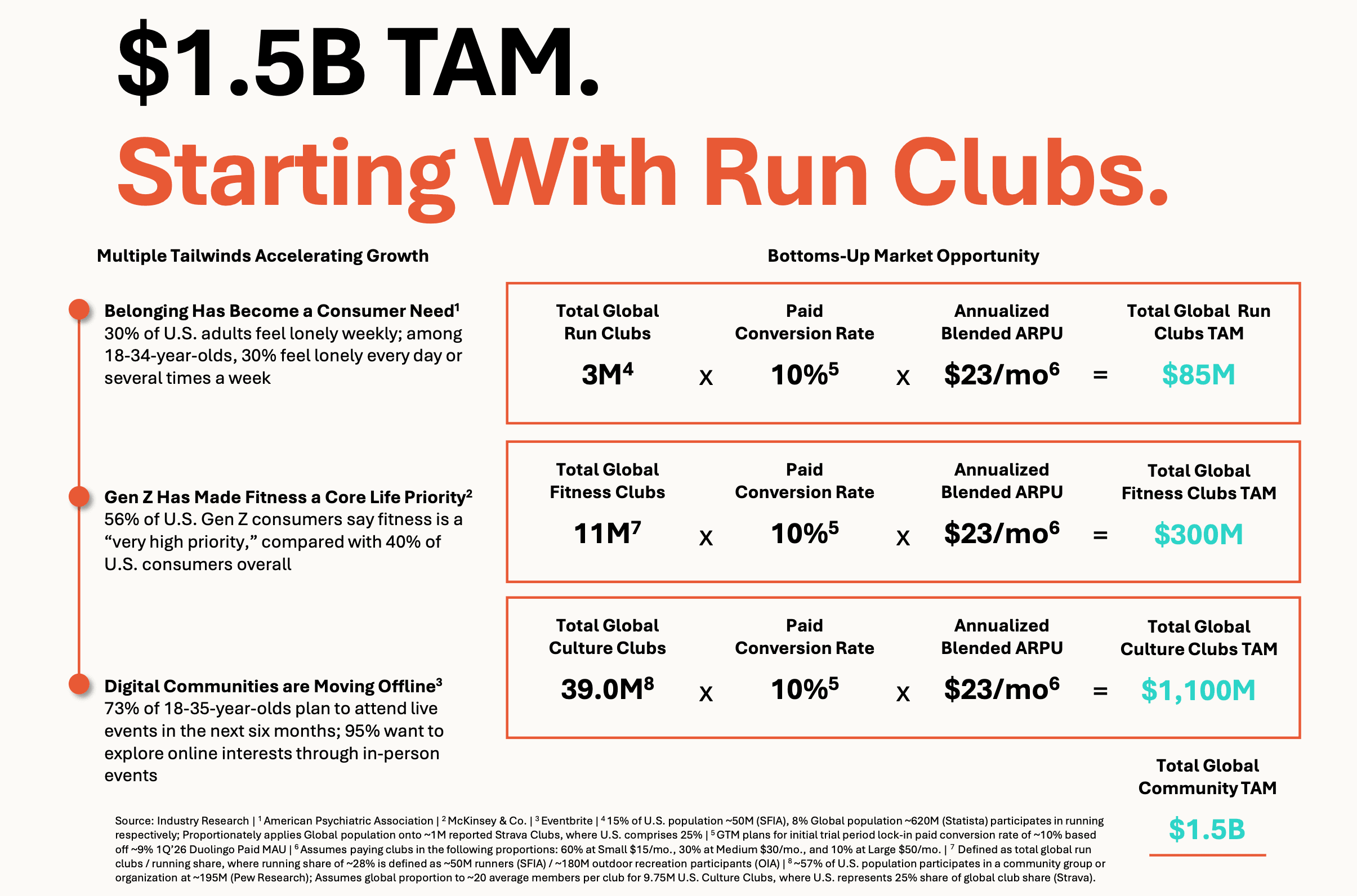
Sources: Industry Research, American Psychiatric Association, McKinsey & Co., Eventbrite, Strava Clubs, Statista, Pew Research, IHRSA.
Product
Multi-tenant, mobile-first, in production today.
Every club gets its own page at weve.community/c/[slug]: member directory, event calendar, check-in flow, contribution log, the club’s contribution record, and a gated perks system.
The core member loop is one tap: show up → check in → log a contribution → climb the leaderboard → unlock the next tier.The founder loop is one dashboard: events, members, club health, contribution types, and tier rewards.
Stack: Next.js 15, React 19, TypeScript, Supabase Postgres with row-level security, Resend for transactional email, Vercel for hosting. Multi-tenant by design: every query is scoped by community_id and enforced by RLS policies and tenant-integrity triggers.
Traction
From 19 in the rain to a live platform in 22 months.
Milestones
Business model
Prove retention first. Charge second.
Selective, unpaid onboarding while the flagship club proved retention and the contribution loop: the founders’ share of the heavy lifting fell from 59% to 42% quarter over quarter. Evidence first, pricing second.
Clubs pay from day one: $29/mo for grassroots clubs, $99/mo for larger retail-backed clubs, locked in as founding rates. Members never pay. Founders pay because the platform replaces a job they were doing for free. The current push: the first five paying clubs.
Open the waitlist into self-serve onboarding at standard per-club pricing once self-serve setup removes the hand-holding from getting a new club live.
Vision & moat
A new category: community contribution.
The defensible asset is the contribution data. Every logged contribution compounds the network: the recommendation engine for new clubs gets smarter, brand-matching for perks gets cleaner, and the ledger itself becomes a credential: a verifiable record of who actually built the things you participate in.
Closest analogs: GitHub for code contribution, Strava for athletic activity. WEVE is the equivalent for community contribution, and nobody else is building it.
Team
Founder-led. Six years of trust.
Clayton founded Stride & Rise, built the WEVE platform end to end, and leads the company as CEO. Henry and Elsie have built with him since Northeastern University in 2020, as the founding team on strategy and design. High-trust, fast-moving, no friction.

Software engineer at Visa Secure on 3D Secure auth infrastructure; prior SWE at Asics. Built the WEVE platform (live at weve.community) on Next.js + Supabase. Grew Stride & Rise, the Austin run club, from 19 members to 321 with $0. Content creator and community builder in one.

Consumer Technology Investment Banking at Wells Fargo. Transactions include Bending Spoons’ acquisition of AOL & Vimeo, and supporting several ongoing Consumer AI IPOs. Past roles at a Series B startup, startup investment bank, and private equity.

Product Designer at Tank Design. Led end-to-end design for Princess Cruises, Fidelity, Boston Globe, and Hilton. High-velocity shipping in scalable UI systems, illustration libraries, motion graphics, and design systems.
The raise
Raising our pre-seed.
We’re raising a pre-seed round now. The product is live, the flagship club proved the loop, and founding-rate pricing is in market with the first outside cohort. The round funds the push from proof to a paying customer base: hands-on onboarding for the founding clubs, the self-serve setup that takes the hand-holding out of onboarding, and the contribution record that compounds with every club.
Most useful to talk to: investors and operators who’ve built community-led products, IRL networks, marketplaces, or lifestyle brands: people with real conviction in grassroots community as a category. If that’s you, reach out below.
Contact
clayton@weve.community · Clayton Yan, Founder & CEO
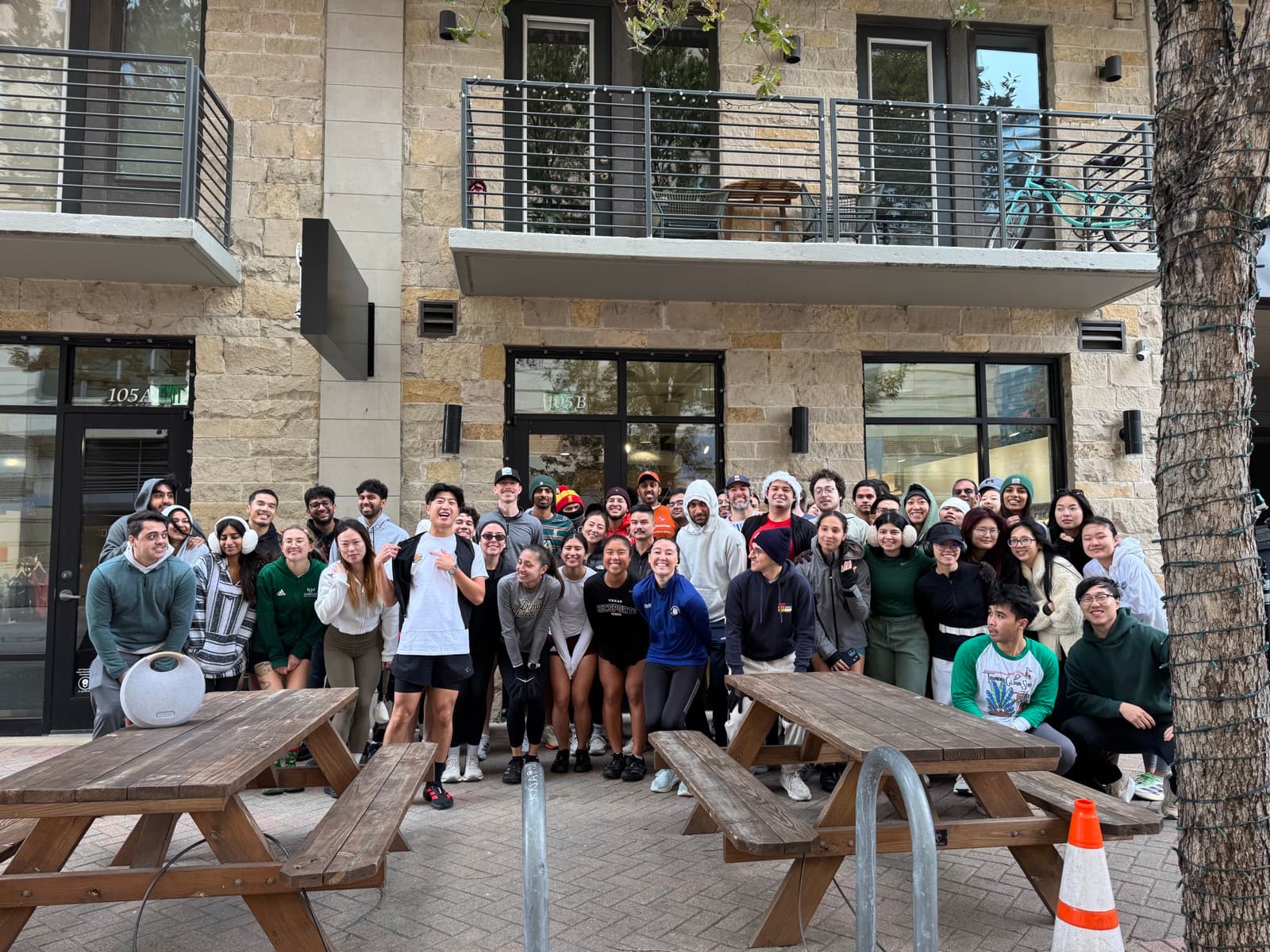
Austin, one year of Stride & Rise.